
When progress stalls, therapists need better tools.
Boundless is the UK’s leading XR Therapy tool, using immersive simulations of real-world environments to make mental health services more efficient and more effective.
Imaginal exposure is too abstract. Real life is too overwhelming. Boundless is the bridge.
Progress stalls because picturing a fear does too little and facing it for real asks too much, too soon. Boundless sits in between: a real situation, at a pace the therapist controls.
Imaginal
Asking a client to picture the situation. Safe, but too removed to shift avoidance.
.png)
Boundless
A real situation, graded and controlled. The client faces it, the clinician leads, progress holds.
In vivo
Facing the real world unaided. Effective in theory, but often too much, too soon.
A real session, with the therapist in control the whole way through.
Boundless gives your clinician a library of clinically designed XR scenes modelled on real-world environments. The client faces what they have been avoiding, gradually and safely, while the therapist guides every step.
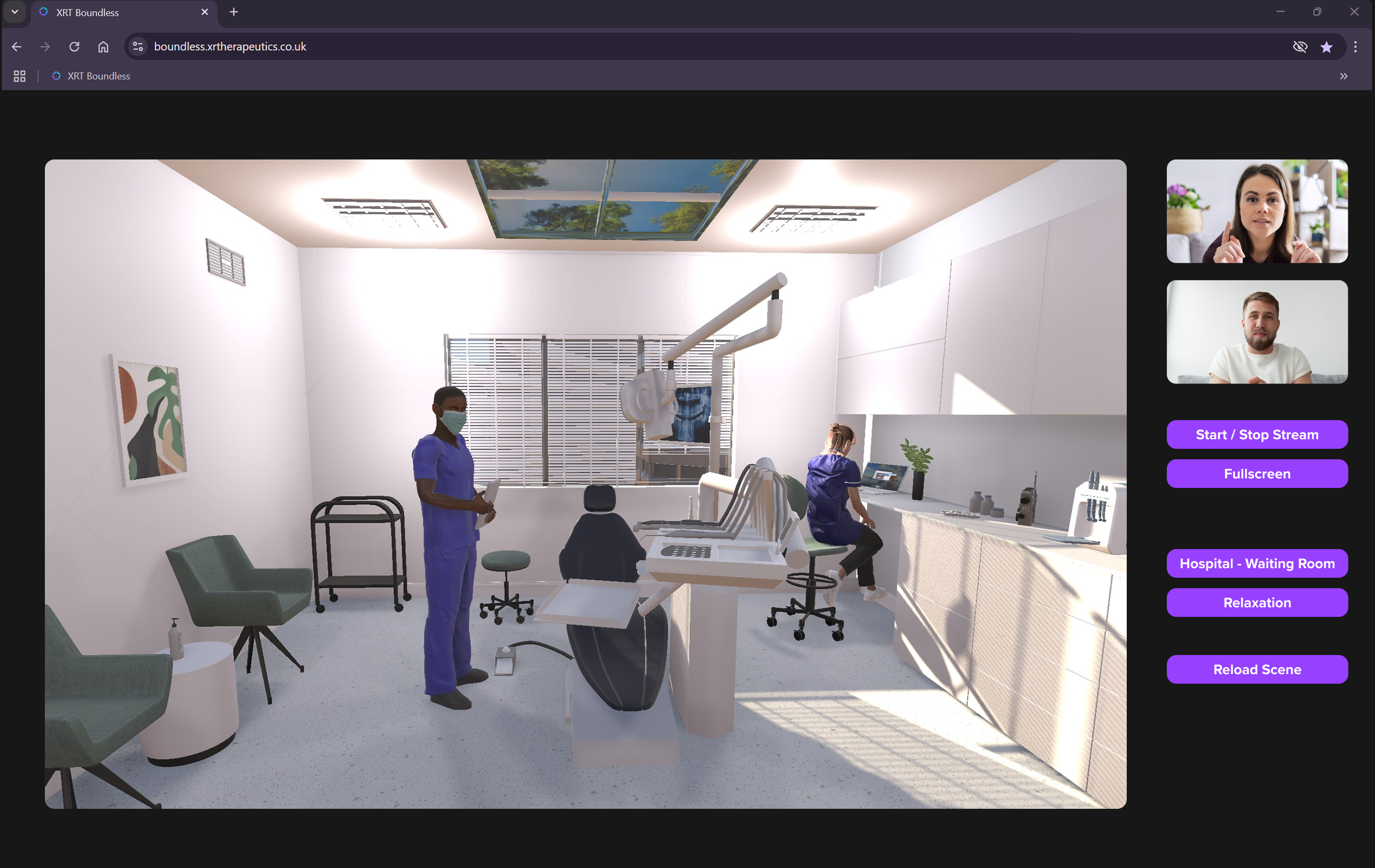
The therapist sets the scene
Your clinician chooses from a library of real situations, matched to the client’s anxiety, phobia, or pattern of avoidance.
The client steps in, safely
They face the moment that usually triggers avoidance, at a pace the therapist sets, from the clinic or from home.
You stay in control
Start, pause, adjust, or change the scene at any point. You see and hear the client throughout, so the relationship leads.
Progress that holds
Each session builds on the last. Outcomes are measured against standard care, so progress is visible to client and service.
More Effective. More Efficient
The impact is undeniable. NICE has stated that CBT should be adapted for neurodivergent children. After seeing these numbers, we’d argue it should be adapted for everyone.
Against 52.6% for standard care. More clients get genuinely better, and stay better, when the situations they avoid are faced with XR therapy.
Of clients show positive improvement across a course of treatment, measured with standard clinical outcome tools.
Clients typically reach their goals in four to eight sessions, against eighteen or more under standard care.
Boundless returns its cost within the same calendar year, and the saving compounds from there.
Roughly ten therapy sessions returned to the service for the next person on the waiting list.
Capacity released back into the service in year one, alongside a 7.0 QALY gain.
Sources: CHEATA Health Economics Report V2 (October 2024), Nottingham University Hospitals NHS Trust. PSSRU Unit Costs of Health and Social Care 2023. NHS Talking Therapies Annual Report 2022/23.
A CAMHS service saves over £1,025 per young person in year one.
That is the conservative, year one figure. It is roughly ten therapy sessions saved per young person, freeing clinician time and treatment courses for the next person on the waiting list.
Use the calculator with your own cohort. The maths is yours to check.
Your savings calculator
A growing library of immersive simulations.
From a packed commute to a needle, a dentist’s chair to an open coastline. Hover over any scene to step inside. Your clinical team can request new XR scenes.
“The whole experience reminded me of previous Cognitive Behavioural Therapy I’ve had in the past but with a bigger impact on bringing the issues to the surface much more clearer and precise.”
You have seen that it is real, it works, and it saves money. Here is where to go next.
Make the case to back it
Get the evidence, the economics, and the governance in one pack, built around your service and your numbers.
Build a business caseSee a session for yourself
Walk through a real session with our clinical team and see exactly how you stay in control throughout.
Book a walkthroughCould this help you?
If anxiety, a phobia, or avoidance is holding you or your child back, talk it through with someone who understands.
Free consultationWe will build the business case with you.
Bring your cohort size and your service pressures. We bring the evidence, the economic model, and the governance documents your finance and clinical leads will ask for.